




Blog
Vibrations in CNC machining: How VH and UP geometry eliminates "chatter" and extends tool life?
Self-excited vibrations, commonly called "chatter" in the industry, are one of the greatest enemies of efficient machining. They lead to faster cutting edge wear, poor surface quality, and in extreme cases, damage to the machine spindle. Although operators often try to fight this phenomenon by reducing cutting parameters, the key to the solution often lies in the design of the CNC tool itself. In this article, we will look at how modern solid milling cutter designs using VH (Variable Helix) and UP (Unequal Pitch) technologies change the rules of the game in high-performance machining.
Do you have questions about selecting tools for your machine? Do you need professional tooling for CNC machine tools? Contact our technical advisors.
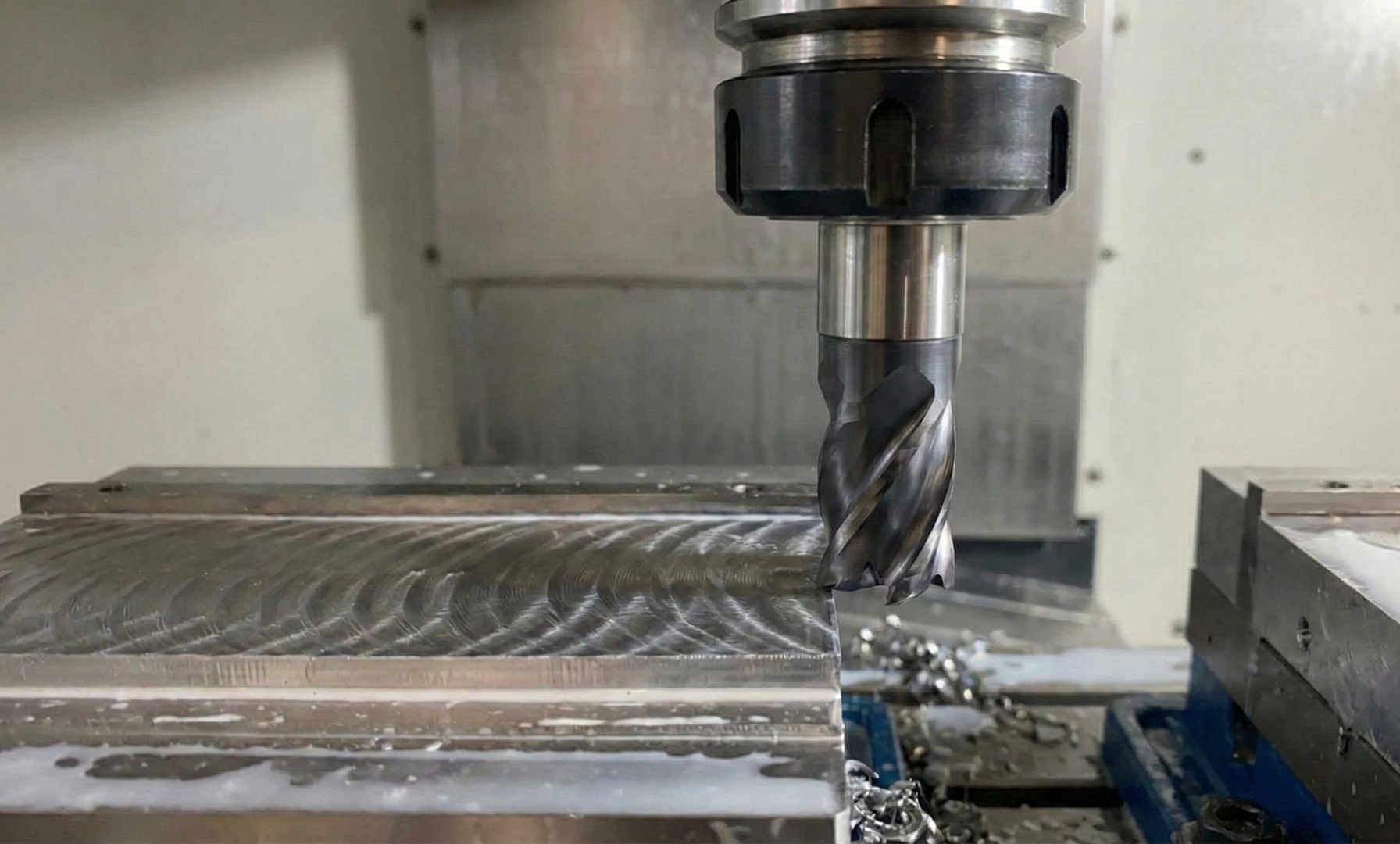
The physics of vibration - why does a milling cutter enter resonance?
During milling, each impact of the cutting edge against the material generates a force that induces vibration. In standard milling cutters, where the cutting edges are arranged symmetrically (equal pitch), these impacts occur at constant, regular time intervals.
If the frequency of these impacts coincides with the natural vibration frequency of the system (machine-holder-tool), resonance occurs. The result is characteristic noise and a wavy workpiece surface.
Engineering solution: Asymmetry as a stabilizer
Manufacturers of high-quality cutting tools, such as Osawa, have introduced solutions that "break up" this regularity, preventing resonance from forming. These are two key parameters:
1. Unequal cutting edge pitch (UP - Unequal Pitch)
In this design, the angles between successive cutting edges are not identical (for example, instead of 90°-90°-90°-90°, there is a varied sequence). This makes the time between successive cutting edge impacts variable. As a result, harmonic vibrations are damped at the source, enabling significantly quieter and more stable operation.
2. Variable helix angle (VH - Variable Helix)
Using different helix angles for the chip flute on individual cutting edges changes the direction and vector of the cutting forces acting on the tool. This further stabilizes the milling cutter in the material, reducing the tendency to pull the tool out of the holder.
Worth knowing: The combination of VH and UP technologies is particularly effective at large cutting depths and in High Performance Cutting (HPC) strategies.
Application in workshop practice
Choosing carbide milling cutters with this geometry translates into specific benefits depending on the type of machining:
- Universal machining: HF6441-type milling cutters using this geometry allow higher feeds while maintaining excellent surface smoothness. Thanks to new carbide substrates, they are resistant to wear across a wide spectrum of materials.
- Trochoidal (dynamic) milling: Rigidity is crucial here. Tools such as OSAWA milling cutters HF535T (5-flute with chip breaker), thanks to their VH+UP design and variable core diameter, allow work at very large depth (high AP) while maintaining stability. The chip breaker additionally facilitates chip evacuation.
- Non-ferrous materials (Aluminum/Copper): In series such as HFA3D, UP geometry reduces vibrations, which are a common problem with thin-walled aluminum components. Combined with a DLC coating and polished flutes, this delivers a mirror-like surface.
Summary
Investing in modern CNC milling cutters with variable geometry is not just a matter of having a "better tool". Above all, it saves machine time and reduces the risk of scrap. By choosing milling cutters from the High Performance series (such as Osawa HF), you gain the ability to work at higher parameters, which directly translates into production profitability.