




Blog
Mirror-like part surface: how the right milling cutters help achieve low Ra?
Every CNC operator knows the satisfying feeling when, after opening the machine door, they remove a part from the fixture with a surface as smooth as a mirror. However, achieving a very low roughness parameter (Ra) is rarely a matter of chance. It is the result of a precisely planned process, rigid clamping and, most importantly, perfectly selected cutting tools.
How can you make a finishing operation deliver the expected "mirror-like" effect? Let’s look at the key factors.
Precision milling cutters and other reliable CNC tools are available in Technar’s regular offer. Our technical advisors will be happy to help you choose the optimal solutions and tooling for your machine park.

1. Cutting edge geometry: Rake angle and number of flutes
Many roughness problems can be avoided already at the tool selection stage. Standard roughing milling cutters are simply not suitable for finishing. What should you pay attention to?
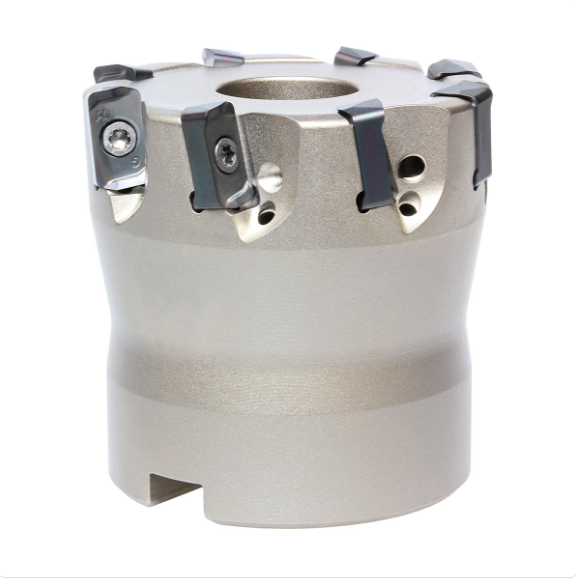
- Higher number of cutting edges (flutes): Multi-flute milling cutters (e.g. 6-, 8- or even multi-edge heads) allow a lower feed per tooth while maintaining a high feed per minute. Each cutting edge removes a microscopic amount of material, which directly translates into a smoother surface.
- Helix angle: Milling cutters with a large helix angle (e.g. 45° or 50°) enter the material more smoothly. This reduces cutting forces and vibrations, which are the main enemy of a smooth surface.
- Wiper geometry: For indexable-insert heads, using a Wiper insert can work wonders by smoothing the "marks" left by standard cutting edges.
2. Carbide and coating quality: why does the brand matter?
For the milled surface to be perfect, the cutting edge must be razor-sharp and free from microdamage. Cheap substitutes often have microscopic chips from the start, which are copied onto the machined part during operation.
The main problem during finishing (especially in soft materials such as aluminum or stainless steel) is built-up edge (BUE) formation on the cutting edge. The solution is highly polished chip flutes and advanced PVD/CVD coatings. If you are fighting for the lowest roughness parameters in difficult materials, it is worth choosing proven premium solutions. A perfect example is Kyocera tools, which, thanks to innovative cermet and sintered carbide grades, provide extreme wear resistance and allow excellent edge quality to be maintained for a very long working time.
3. Cutting parameters: the golden rule of finishing
Even the best CNC tools will not do their job if you enter incorrect parameters into the control. The general rule for finishing operations aimed at low Ra is:
- High cutting speed (Vc): Reduces the risk of built-up edge formation and helps produce a smooth chip separation.
- Low feed per tooth (fz): Determines the theoretical surface roughness. The lower the feed, the more densely the tool marks are arranged.
- Minimal allowance (ap / ae): The finishing tool should remove only tenths, and sometimes even hundredths, of a millimeter. Its task is not to remove a large volume of material, but to "skim" the surface.
4. Tooling and chip evacuation
Radial tool runout will cause one cutting edge of the milling cutter to "take" more material than the others, leaving clear, cyclic scratches on the part. Use the most rigid and balanced tool holders possible (e.g. shrink-fit or hydraulic).
The last, but equally important, element is proper flushing of the working area with CNC coolant. Leaving chips in the cutting zone will cause them to be cut again (so-called recutting), which will immediately scratch the finished, mirror-like surface.
Summary
Low Ra and a mirror-like surface are the hallmark of a professional workshop. They require investment in high-class milling cutters for finishing, stable clamping and rigorous adherence to cutting parameters.