




Banner
Milling on a Lathe - Selecting CNC Drills and Driven Tools for Multitasking Centers
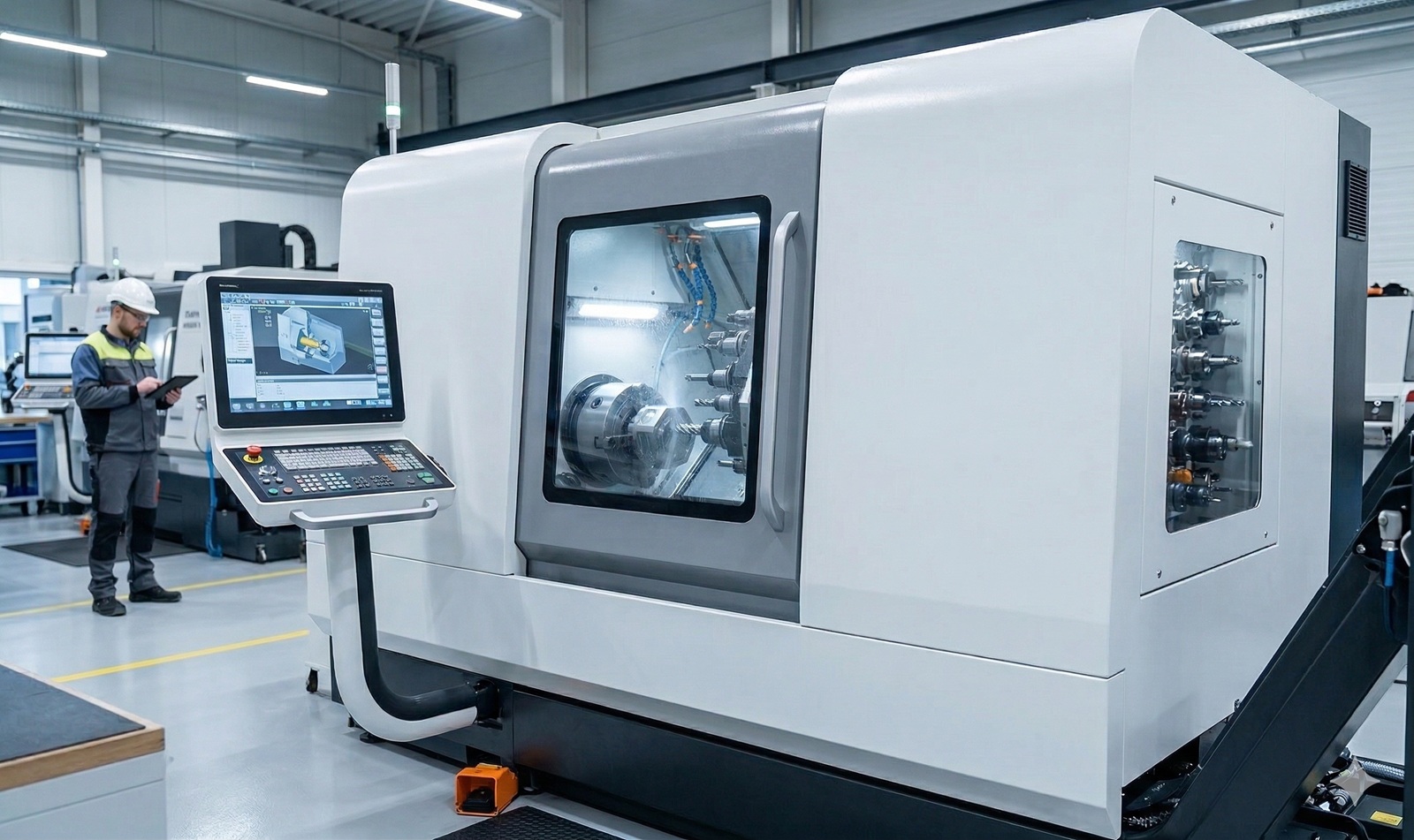
In 2026, the boundary between turning and milling has almost completely disappeared. Modern multitasking centers (Mill-Turn) make it possible to produce a complex workpiece "ready to use" in a single setup. However, what is standard on a vertical machining center becomes a technological challenge on a lathe. Effective milling on a lathe requires not only a Y-axis, but above all a conscious selection of CNC tools that can handle limited space and the specific drive characteristics of the turret.
Looking for solutions that will let you fully use the potential of your lathe with driven axes? At Technar, we offer specialist cutting tools from leading manufacturers, including advanced drilling and milling systems that perform well in the most demanding industrial applications.
Drive Characteristics and Rigidity of the M-H-W-T System
Unlike milling spindles, driven holders in a lathe, both in the VDI standard and the more rigid BMT version, have limited torque and lower mass. This means that cutting tools must be selected with a focus on minimizing radial forces.
- Short overhangs: On a lathe, every millimeter of tool length drastically reduces rigidity. It is recommended to use milling cutters and drills in short versions (K) to avoid harmonic vibrations, which are more difficult to eliminate on a lathe than on a milling machine.
- Low-resistance geometry: Modern CNC tools dedicated to multitasking centers have special polished chip flutes that make chip formation easier with less load on the driven holder spindle.
CNC Drills - The Key to Horizontal Efficiency
Drilling on a lathe using rotating tools often takes place on a horizontal axis, which makes gravitational chip removal difficult. Therefore, when selecting CNC drills for such operations, pay attention to two aspects:
1. Internal coolant (HPC): With modern High Pressure Coolant systems, drills with internal channels are absolutely essential. They allow chips to be literally "flushed" out of the hole, preventing them from being recut and preventing tool breakage in the tight working area.
2. Indexable vs solid drills: In Mill-Turn operations, indexable drills with replaceable inserts are used increasingly often. They provide greater flexibility and often also enable light boring or chamfering of the hole with the same tool, saving valuable space in the turret magazine.
Space Management and Collision Avoidance
The greatest challenge when setting up a multitasking machine is avoiding collisions between long cutting tools and neighboring stations or cabin components. When selecting CNC tools, you should always verify their overall length in the context of turret rotation.
- Using quick-change systems, such as Capto-type systems, makes it possible to shorten changeover time and increase positioning repeatability.
- It is worth using CAD/CAM tool libraries to run a digital twin simulation before producing the first workpiece.
Summary - How to Optimize the Process?
Success in machining on multitasking centers depends on the balance between the machine drive capabilities and the geometry of the cutting edge. Properly selected CNC drills and milling cutters with smooth operation are the only way to shorten cycle times while maintaining high surface quality.