




Blog
End Mills, Drills, Turning Tools - How to Build a Universal CNC Tool Set?
Every operator, whether an experienced technologist or the owner of a new machining center, faces the same challenge: selecting CNC tools. Putting together a universal set that can handle most everyday tasks is the key to smooth and efficient work. Instead of buying dozens of specialized tools, it is worth building a solid base that can be expanded as needed. In this article, we suggest how to create a versatile starter set based on the three pillars of metal cutting: milling cutters, drills, and turning tools.
Need help putting together the perfect set for your needs? Contact Technar experts - we will gladly advise you and select CNC solutions that maximize your production efficiency. Find a regional representative.
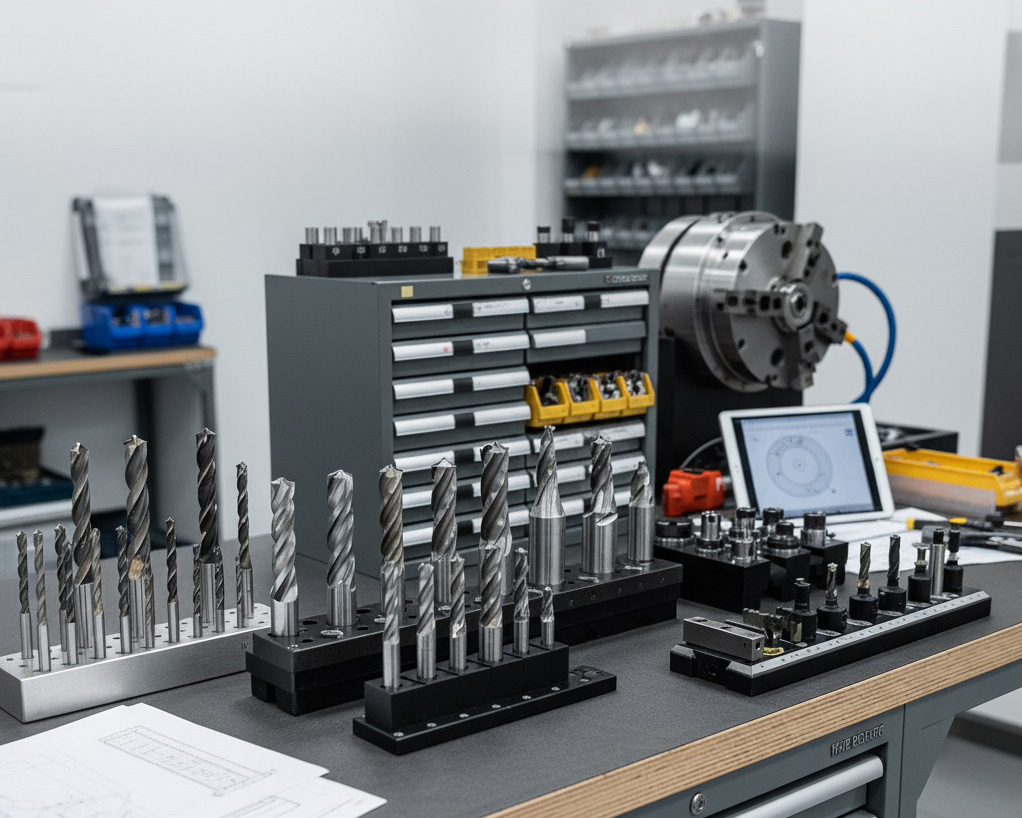
The foundation of every workshop - three main tool groups
Versatility in CNC machining is based on the ability to perform three basic operations: milling, drilling, and turning. That is why your initial set of cutting tools should include representatives of each of these groups. Focusing on high-quality solid carbide (VHM) tools is an investment that pays off in better part quality, longer tool life, and a lower risk of failure.
1. End mills - essentials for machining on a CNC milling machine
Milling is fundamental in every workshop. From face milling, through pockets and slots, to 3D contour machining. To start, three basic types of milling cutters are enough.
-
Flat end mills (VHM):
The absolute "workhorse". Indispensable for most tasks.
2-flute version: Ideal for machining aluminum and other soft metals, where effective chip evacuation is key. -
4-flute version:
More universal, excellent for machining steel, providing greater stability and better surface quality.
Recommendation: Start with diameters ø6, ø8, ø10, and ø12 mm. -
Ball nose end mill (VHM):
Essential if you plan to machine 3D shapes, molds, or radii. It provides a smooth finish on curved surfaces.
Recommendation: For a start, a diameter of ø8 or ø10 mm is enough. -
Face milling cutter:
For fast and efficient machining of large, flat surfaces. Instead of a solid tool, it is worth investing in a cutter body for
indexable inserts. This is an economical solution that allows only worn cutting edges to be replaced.
Recommendation: A cutter with a diameter of approx. 50-63 mm will be a good universal choice.
2. CNC drills - precision in every hole
Drilling seems simple, but it is an extremely important operation. Precisely made holes are often the basis for further processes such as tapping or reaming.
-
Solid carbide twist drills (VHM):
This is the standard in modern CNC machining. They offer high rigidity, precision, and the ability to work at high speeds.
Recommendation: It is worth stocking a set of basic diameters for the most popular threads, e.g. ø4.2 mm (for M5), ø6.8 mm (for M8), ø8.5 mm (for M10). -
Center drill (or spotting drill):
A key tool for ensuring precision. It is used to make a small indentation that guides the actual drill, preventing it from "walking" across the material surface.
Recommendation: A 90° or 120° center drill is a universal choice.
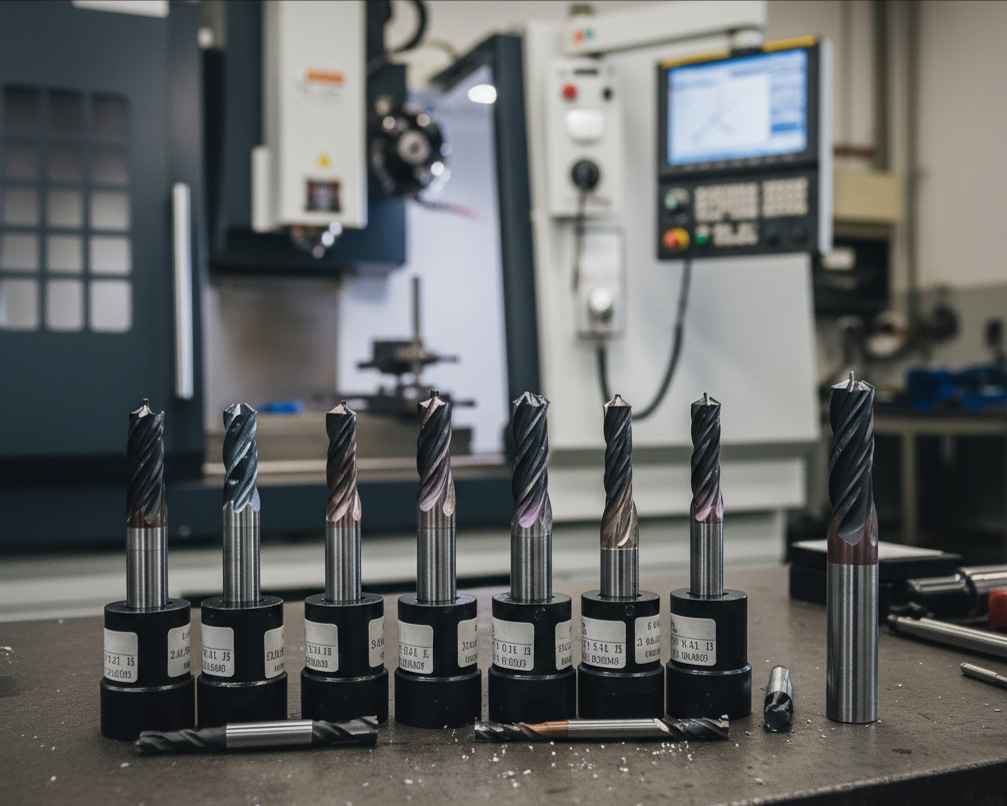
3. Turning tools - the basis of lathe machining
For turning, the most flexible and economical approach is a system based on toolholders and replaceable indexable inserts. One turning tool can be used for many tasks; simply change the insert.
-
Indexable turning tool for external turning (basic):
The most important turning tool, used for longitudinal turning and facing the workpiece.
Recommendation: An SCLCR or SDJCR type shank with rhombic inserts (CCMT, DCMT) is a great choice to start with. - Parting and grooving tool: Essential for cutting finished parts off the bar and for making external grooves.
-
Boring bar:
The counterpart of an external turning tool, but intended for work inside the part. It is used to enlarge and finish existing holes.
Recommendation: It is worth choosing a holder for the same inserts as the external tool, which reduces the number of consumables needed.
In this category, it is worth paying attention to renowned manufacturers. Kyocera tools offer excellent quality of inserts and holders, which translates into machining repeatability and productivity.
Table: Universal starter set of CNC tools
| Tool Category | Tool Type | Suggested Application | Material |
|---|---|---|---|
| End Mills | 4-flute flat end mill | Pockets, slots, roughing and finishing in steel | Solid carbide (VHM) |
| End Mills | 2-flute flat end mill | Machining aluminum and non-ferrous metals | Solid carbide (VHM) |
| End Mills | Ball nose end mill | Finishing 3D surfaces, molds | Solid carbide (VHM) |
| End Mills | Face milling cutter | Fast facing of large surfaces | Indexable insert type |
| CNC Drills | VHM twist drill | Precision holes in various materials | Solid carbide (VHM) |
| CNC Drills | Center drill | Spotting for drilling, chamfering | Solid carbide (VHM) |
| Turning Tools | External turning tool | Longitudinal turning, facing | Indexable insert type |
| Turning Tools | Parting and grooving tool | Parting off components, making grooves | Indexable insert type |
| Turning Tools | Boring bar | Internal turning (holes) | Indexable insert type |
Summary: Quality is the foundation
When putting together your first set of CNC tools, remember the golden rule: quality over quantity. It is better to start with a few high-class, universal tools from reputable brands than with a large set of cheap products with uncertain durability and precision. A well-selected base will allow you to complete 80% of typical jobs, while the knowledge and funds gained can be used to gradually expand your tooling with more specialized cutting tools.