




Blog
Coatings in HSS drills - TiN, TiAlN, or TiCN? How to choose the right surface treatment for the material?
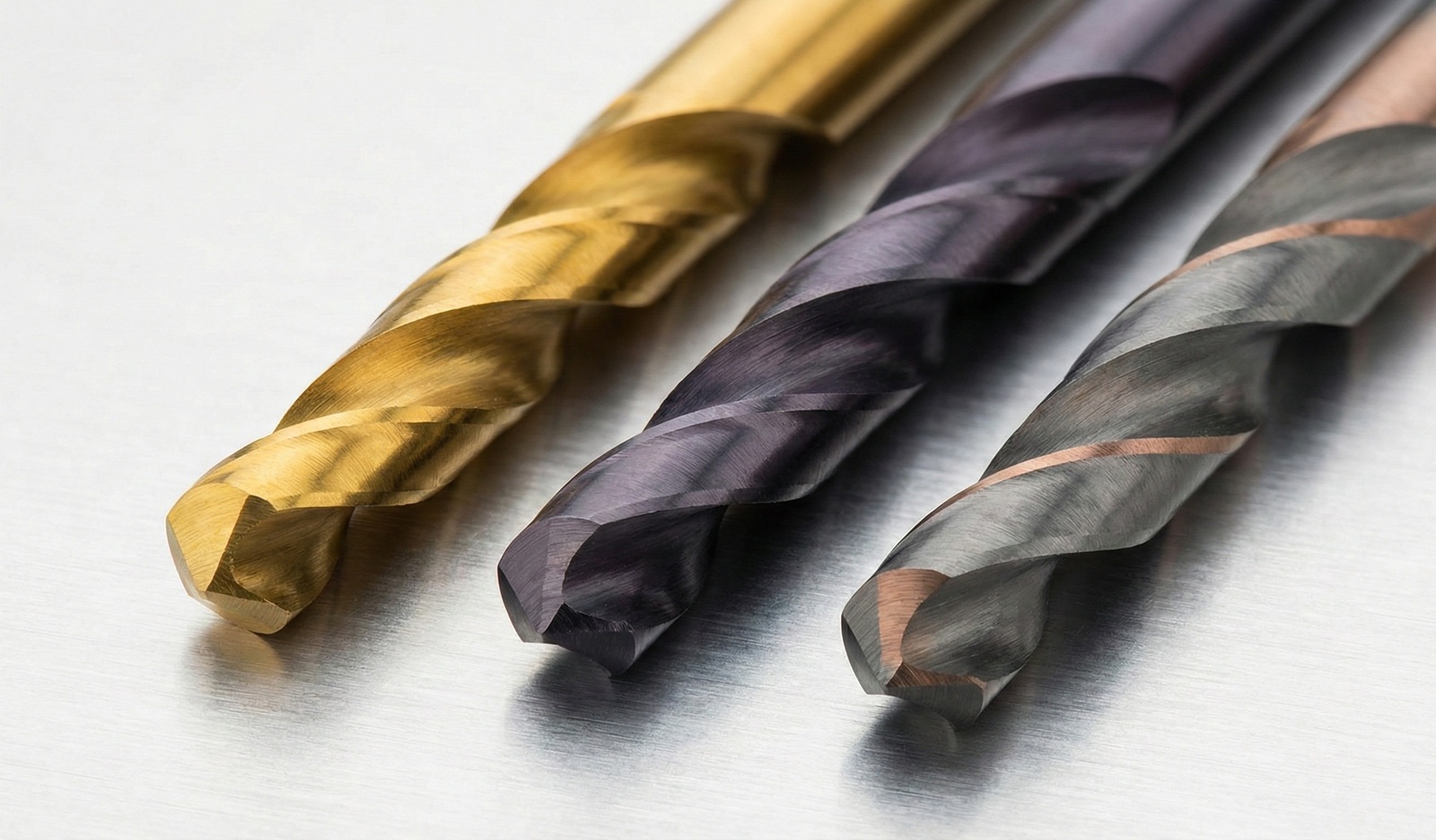
Many operators and purchasing specialists ask themselves: why does the same drill come in three different prices and colors? Gold, purple, gray - this is not a matter of aesthetics, but chemistry and physics, which have a crucial impact on production efficiency. High-speed steel (HSS) drills still form the foundation of machining in many workshops, and the use of the right PVD coating allows them to compete in performance even in more demanding applications. In this article, we explain the differences between the most popular coatings: TiN, TiAlN, and TiCN, and suggest how to choose cutting tools so as not to overpay while extending cutting edge life.
Are you looking for proven HSS drills or need comprehensive advice on selecting cutting tools? Contact us now - Technar experts will help you match the ideal solution to your machine park.
Why coat HSS drills at all?
High-speed steel itself (even with cobalt added, i.e. HSS-Co) has thermal and tribological limitations. During drilling on CNC machines, where speeds are high, enormous friction and temperature arise at the interface between the drill and the material. Coatings applied by PVD (Physical Vapor Deposition) are layers several micrometers thick that are much harder than the steel itself.
The use of coatings in CNC drills provides three main benefits:
- Increased surface hardness - the coating protects the cutting edge against abrasion.
- Reduced friction - the chip moves more easily along the flute, which reduces the risk of jamming and lowers cutting forces.
- Thermal barrier - the coating insulates the drill core from the heat generated in the cutting zone.
Coating overview: TiN, TiAlN, TiCN - how do they differ?
1. TiN - titanium nitride (Color: gold)
This is the most popular, "classic" coating, recognizable by its characteristic gold color. It is an excellent universal choice.
- Hardness: approx. 2300 HV.
- Thermal resistance: up to approx. 600°C.
- Application: Basic HSS drills coated with TiN work very well in unalloyed steels, soft cast iron, and copper.
- When to choose? When you are looking for an economical solution for general workshop tasks and bench drills, rather than extreme CNC parameters.
2. TiAlN - titanium aluminum nitride (Color: purple / dark gray)
This is the "king" of performance in the HSS world. The TiAlN coating is harder and much more temperature-resistant than TiN. Interestingly, at high temperatures, aluminum oxide forms on its surface, providing additional tool protection.
- Hardness: approx. 3300 HV.
- Thermal resistance: up to approx. 800-900°C.
- Application: Ideal for stainless steels, acid-resistant steels, alloy steels, and cast iron.
- When to choose? If your CNC drills dull quickly due to overheating or you machine more difficult materials (e.g. stainless steel). Drills with this coating allow work at higher cutting parameters (Vc).
3. TiCN - titanium carbonitride (Color: blue-gray / copper)
A multilayer coating that is a compromise between hardness and impact resistance. It is characterized by a very low coefficient of friction.
- Hardness: approx. 3000 HV.
- Thermal resistance: up to approx. 400°C (lower than TiAlN!).
- Application: Drilling difficult-to-machine materials, but at lower cutting speeds and high feeds. Often used on taps and milling cutters, less often on standard HSS drills, unless for specific steels with high abrasiveness.
How to choose a drill for the material? A short cheat sheet
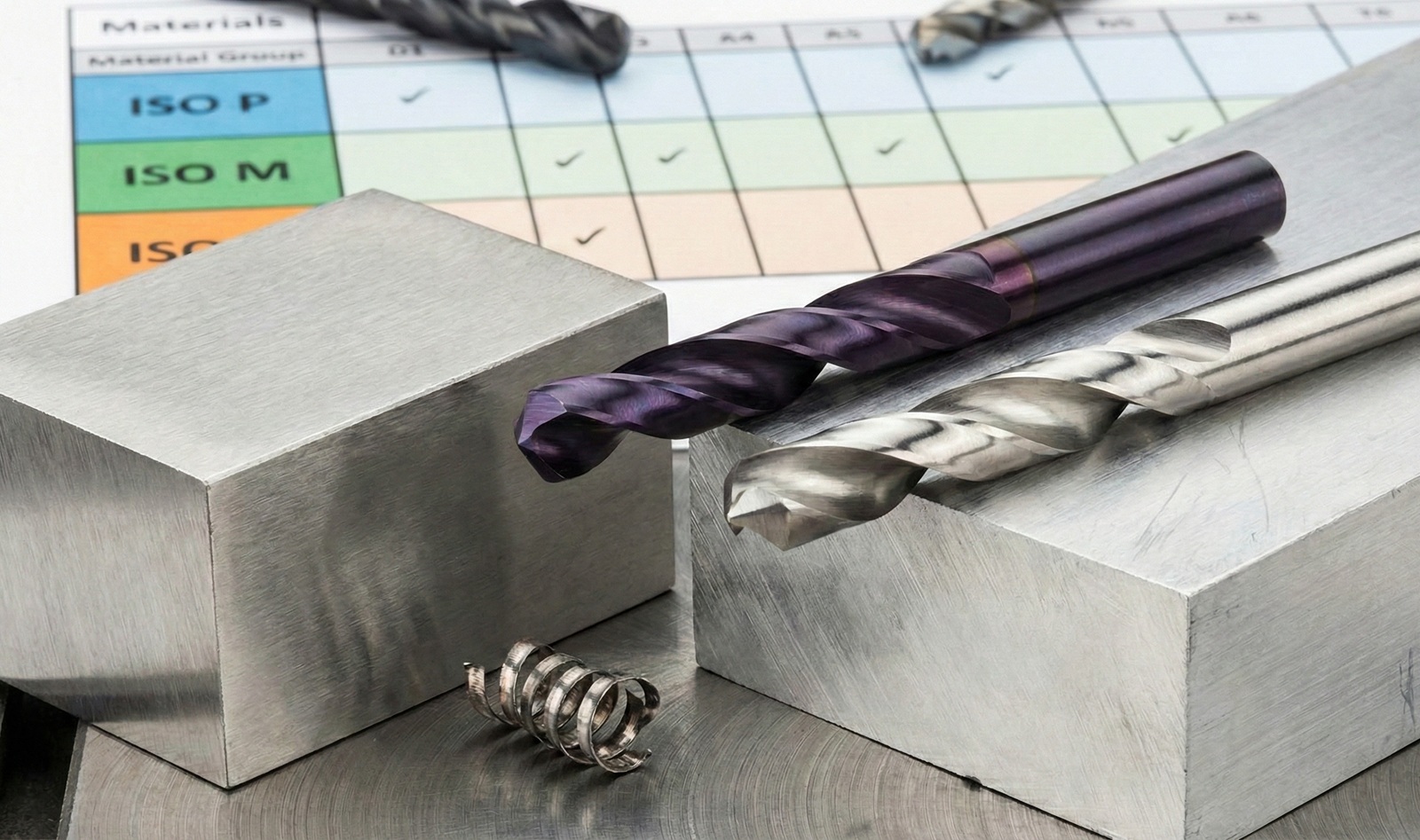
To avoid mistakes, it is always worth checking manufacturers' tool catalogs, which precisely define material groups (ISO P, M, K, N, S, H). Below is a general rule for selecting HSS drills:
- Plain steel (S235, S355): A black oxide HSS drill or HSS-TiN (gold) is sufficient. It will provide good chip sliding and adequate durability.
- Stainless steel (304, 316): A standard gold drill may fail quickly here. Choose an HSS-Co (cobalt) drill, preferably with a TiAlN coating. Stainless steel "does not like" heat, and TiAlN dissipates it best.
- Cast iron: A highly abrasive material. We recommend TiAlN or TiCN drills due to the high coating hardness.
- Aluminum: Note! Standard TiN or TiAlN coatings are not recommended for aluminum. Aluminum reacts chemically with titanium, causing chips to "stick" to the drill (built-up edge). For non-ferrous metals, polished >HSS drills (uncoated) or special DLC (Diamond Like Carbon) coatings are best.
Summary
Choosing the right coating is the simplest way to "tune" the drilling process without investing in expensive solid carbide (VHM) drills. Remember, however, that even the best coating will not help if the drill geometry is poorly selected or cooling is inefficient. If you are not sure which CNC drills will be best for your project, contact Technar advisors.